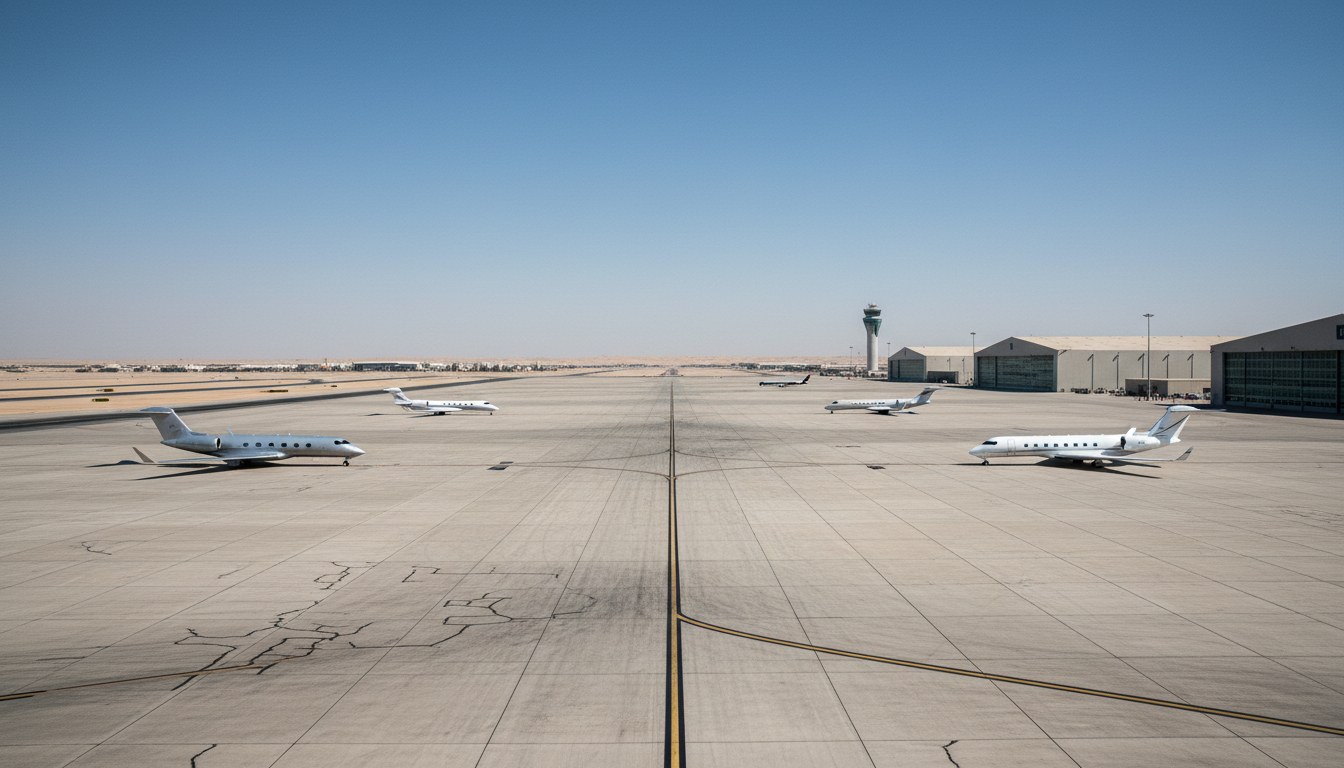
Al Maktoum International handles fewer business jets per day than Teterboro handles per hour. For an airport designed as Dubai's aviation future, that's a spectacular miscalculation.
Dubai World Central, as the airport is officially known, opened in 2013 with grand ambitions: a $32 billion project sprawling across 140 square kilometers, positioned to become the world's largest airport by passenger capacity. The emirate's aviation planners envisioned DWC as the natural successor to Dubai International, drawing private jets away from the congested DXB with modern infrastructure and dedicated business aviation facilities.
It hasn't worked. Seven years after opening its doors to commercial traffic, Al Maktoum processes roughly 40 business jet movements per week—a fraction of what Dubai International still handles despite its slot constraints and operational complexity. The Middle East Business Aviation Association's 2023 traffic data shows DWC capturing less than 15% of Dubai's private jet operations.
The failure stems from a fundamental misreading of how business aviation actually works. DWC sits 37 kilometers southwest of Dubai's central business district, a 45-minute drive in light traffic that can stretch to 90 minutes during peak hours. Compare that to DXB's 10-minute helicopter hop to the city center, or its seamless connection to the Dubai Metro.
Location matters more in private aviation than almost any other transport mode. Business jet passengers pay premium rates specifically to avoid inconvenience—the extra hour each way to reach DWC negates much of the time savings that justify charter costs in the first place.
The infrastructure tells a similar story of misplaced priorities. DWC's two FBOs, ExecuJet and Jetex, occupy state-of-the-art facilities with marble lobbies and conference rooms that rival five-star hotels. But the airport lacks the ecosystem that makes DXB attractive: maintenance shops within walking distance, parts suppliers, crew rest facilities, and the critical mass of operators that enables last-minute aircraft swaps or crew changes.
"You can have the most beautiful terminal in the world, but if it takes two hours round-trip just to get to your meetings, operators will choose DXB every time," notes one Gulf-based charter broker who spoke on condition of anonymity.
The numbers bear this out. Despite DWC's lower landing fees and faster turnaround times, utilization at its business aviation facilities runs at roughly 30% capacity. Meanwhile, DXB's general aviation terminal operates at near-saturation, with slots booking weeks in advance during peak season.
Dubai's aviation authority has quietly acknowledged the misstep. Recent infrastructure spending has focused on upgrading DXB's private jet facilities rather than promoting DWC. The new $2.9 billion expansion at Dubai International includes dedicated business aviation gates—a tacit admission that proximity trumps purpose-built infrastructure.
Al Maktoum International will likely find its niche eventually, perhaps as cargo hub or overflow facility during Dubai's peak winter season. But its failure as a business aviation destination offers a costly lesson: in private aviation, convenience isn't a luxury—it's the entire product.
Sources
References used in this article
- Middle East Business Aviation Association2023 traffic data
- Dubai Airports AuthorityInfrastructure spending figures
- Aviation WeekDWC utilization rates
- FlightGlobalBusiness aviation facility analysis