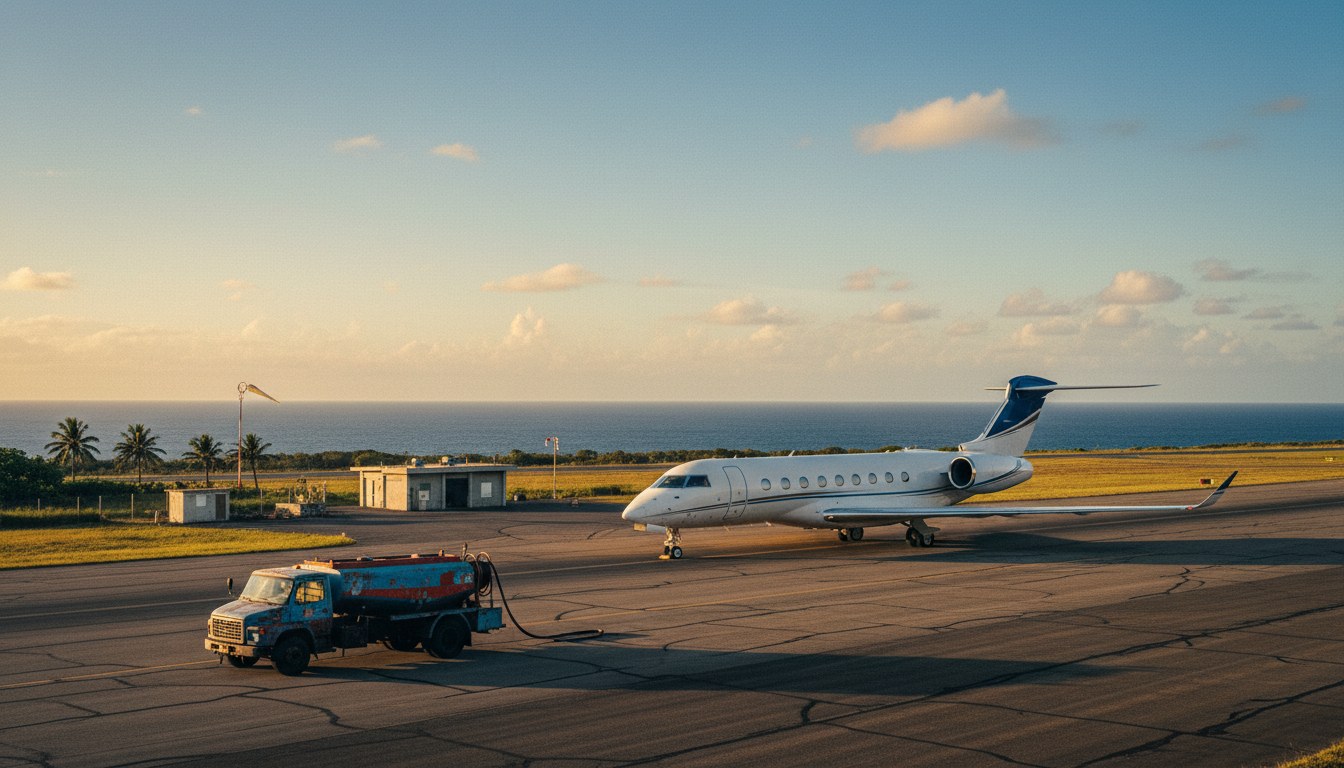
Bombardier's marketing materials proudly tout the Global 7500's 7,700-nautical-mile range—enough to fly nonstop from New York to Hong Kong or Los Angeles to Sydney. The reality flying into headwinds with actual passengers and their luggage? You're landing 500 nautical miles short.
The culprit isn't false advertising, exactly. It's the gap between laboratory conditions and operational reality that plagues every aircraft manufacturer's maximum range claims. Bombardier certifies that 7,700nm figure with four passengers, optimal weather, and fuel reserves calculated to the legal minimum. But step aboard with eight passengers, their bags, catering, and face a 50-knot headwind over the Pacific, and suddenly that Sydney trip requires a fuel stop in Fiji.
FlightAware data from actual Global 7500 operations tells the story. The longest recorded nonstop flights consistently clock in around 6,200 to 6,400 nautical miles—a 15-20% reduction from the advertised maximum. The math is unforgiving: each additional 200 pounds of payload costs roughly 40 nautical miles of range. Add typical business loads—eight passengers instead of four, full catering, extra baggage for a week-long trip—and you've burned through 300 nautical miles before leaving the ground.
Weather compounds the problem. NBAA fuel consumption studies show that headwinds above 25 knots can reduce practical range by another 8-12%, depending on flight level and routing. The jet stream over the North Pacific regularly clocks 80+ knots in winter, turning that advertised Hong Kong run into a mandatory Anchorage fuel stop.
Bombardier isn't uniquely guilty here. Gulfstream's G700 claims 7,500 nautical miles but faces identical real-world penalties. Dassault's Falcon 8X promises 6,450nm yet operators routinely plan for 5,800nm with realistic loads. The industry tacitly acknowledges this gap—experienced flight departments automatically subtract 500-800 nautical miles from any manufacturer's maximum range claim when planning actual missions.
The disconnect matters because these ultra-long-range aircraft command premium prices partly based on their range capabilities. A Global 7500 lists around $75 million, with much of that premium justified by its Pacific-crossing capability. But if real-world range limitations force the same fuel stops as cheaper alternatives, the value proposition shifts.
Some operators have learned to game the system. They'll position extra fuel at departure, flying with minimal reserves to squeeze maximum range, then refuel at the destination. Others simply plan every long mission with a technical stop, treating maximum range as a marketing fiction rather than an operational reality.
The solution isn't better marketing—it's better planning. Savvy buyers now demand performance guarantees based on their specific mission profiles: eight passengers, full bags, realistic weather routing. They're discovering that the aircraft promising the longest paper range isn't always the one that flies farthest when it counts.
Sources
References used in this article
- BombardierGlobal 7500 specifications
- FlightAwareFlight tracking data
- NBAABusiness aviation fuel studies
- Aviation WeekAircraft performance analysis